14-Day Returns* · 2-Year Warranty · Worldwide Shipping, US included

14-Day Returns* · 2-Year Warranty · Worldwide Shipping, US included
14-Day Returns* · 2-Year Warranty
Worldwide Shipping, US included
14-Day Returns*
2-Year Warranty
Worldwide Shipping, US Included
Guide
Compare OWO vs TrueGear across haptics, games, battery, fit, platforms and price
by
OWO
-
September 29, 2026
Reading Time:
8 min read
OWO and TrueGear both bring physical feedback beyond the controller and onto your body. They even share one important technology: both can use electrical stimulation.
But that similarity disappears once you look at how each system is built.
TrueGear takes a hybrid approach. Its vest combines 40 ERM vibration units across the torso with two separate electrical stimulation modules worn on the arms.
OWO takes a different route. There are no vibration motors. Supported game events are translated into distinct physical sensations using controlled electrical stimulation across 10 individually calibrated muscle zones.
If deeper immersion and sensations beyond conventional vibration are the reason you are investing in wearable haptics, OWO is our recommendation.
Choose TrueGear if your priorities are a lower entry price, much longer battery life, an adjustable one-size design and a hybrid combination of vibration with additional arm stimulation for PCVR.
At first glance, TrueGear may look closer to OWO than other vibration-based haptic vests because both products include electrical stimulation.
But the role electrical stimulation plays in each system is very different.
Deeper electrical stimulation integrated across the body instead of relying primarily on vibration.
Lower price, long battery life and an adjustable hybrid vibration + EMS system.
40 vibration units and 10 active muscle zones are not directly comparable numbers.
One describes the number of mechanical vibration points. The other describes areas where controlled electrical stimulation is delivered to the wearer’s body.
TrueGear takes a hybrid approach.
Its vest places 40 ERM vibration units around the torso to communicate impacts, direction and other game events. Two additional electrical stimulation modules can be worn around the arms.
That gives TrueGear more than conventional vibration alone.
But electrical stimulation is not the foundation of the vest itself.
OWO starts from the opposite direction.
There are no vibration motors inside OWO Skin.
Its haptic experience is built around controlled electrical stimulation from the beginning, with 10 active muscle zones calibrated to the individual wearer.
That difference changes what the product is trying to achieve.
A vibration motor produces mechanical movement against the body.
OWO instead sends carefully controlled signals through electrodes connected to specific areas of the body, allowing supported actions to use different physical sensation profiles.
TrueGear adds electrical stimulation to a vibration vest.
OWO builds the haptic experience around electrical stimulation.
If moving beyond vibration is the reason you are considering a premium haptic wearable, we believe OWO represents the more fundamental technological step.
OWO does not literally reproduce every possible physical experience.
The individual game integration determines which events are supported and which sensations are assigned to them.
But those sensations are not limited to deciding which motor should vibrate or how strongly it should move.
The controller provides a simple physical signal that something happened.
40 vibration units create spatial body feedback, complemented by two arm EMS modules.
Supported actions can become distinct sensations across calibrated muscle zones without relying on vibration motors.
For players specifically looking for a haptic vest because they want to experience something beyond vibration, that is why we recommend OWO.
Ten active muscle zones are individually calibrated to the wearer. Supported game events can use different sensation profiles for impacts, recoil, tension and environmental effects.
Forty ERM vibrotactile units provide feedback around the Vest, while two separate electrical stimulation modules add EMS feedback to the arms.
The TrueGear approach makes sense if you want highly distributed directional vibration with an additional electrical element.
Forty vibration points can provide a detailed map of where something is happening around your torso.
OWO solves a different problem.
Instead of adding electrical stimulation around the edges of a vibration system, OWO removes vibration from the equation entirely.
The electrical signal itself becomes the tool used to design the sensation.
This is the distinction we think matters most:
TrueGear uses vibration as its primary torso feedback and supplements it with EMS on the arms.
OWO uses controlled electrical stimulation as the core haptic language across the Vest.
Consider what happens during a few seconds of gameplay.
You fire a weapon.
You receive an impact.
Your character experiences tension.
An environmental effect passes across the body.
With vibration, those events can be communicated through changes in location, timing, strength and pattern.
OWO adds another possibility: the physical character of the sensation itself can change.
Recoil does not have to be another version of a mechanical buzz.
An impact does not have to be communicated only through a different vibration pattern.
Supported events can be designed with different physical sensation profiles.
For players looking specifically for deeper embodiment, that difference is central to our recommendation.
OWO does not win every specification.
The competing system has several genuine advantages that should be part of the buying decision.
TrueGear states more than twice the approximate battery runtime of OWO.
TrueGear currently has a substantially lower advertised entry price.
Shoulder and side adjustment makes the same device easier to fit across different users.
A large number of ERM motors provides detailed spatial vibration across the torso.
*TrueGear pricing is promotional and may change.
Those are meaningful advantages.
If you want an inexpensive entry into full-torso haptics, particularly for PCVR, The system offers an unusually large amount of hardware for its price.
But more hardware points do not automatically mean a deeper sensation.
The question is what those points are actually doing to your body.
Both systems depend on game support to deliver their intended haptic experience.
TrueGear advertises compatibility with more than 100 mainstream SteamVR games.
OWO currently supports more than 165 titles across native integrations, mods, SimHub and other integration routes.
But raw totals are only part of the decision.
Before choosing:
Many major VR titles appear across both ecosystems.
That makes the type of haptic experience more important than simply asking whether a game appears in both lists.
Direct integrations connect supported game events to OWO sensations.
Dedicated modifications extend OWO into additional PC and PCVR games.
Telemetry-based integrations bring physical feedback into racing, flight and simulation titles.
Another supported integration route for selected PC experiences.
This is where the two ecosystems separate more clearly.
The manufacturer currently states that its haptic suits work through PC streaming with SteamVR.
That means a headset such as Meta Quest can be part of a TrueGear setup when the game is being streamed from a compatible PC, but TrueGear does not currently support standalone VR use.
OWO covers a broader range of gaming environments.
Compatible experiences are available across PC, PCVR, Meta Quest and supported console environments, depending on the individual game integration.
The system currently requires PC streaming and SteamVR. Standalone headset support is listed as still in development.
For a PCVR-only player, that limitation may not matter.
For someone who wants more flexibility across different gaming environments, OWO has the broader platform proposition.
The physical construction reflects the different technologies inside each product.
OWO calibrates active muscle zones individually so intensity can be adapted to the wearer.
Sizes from 2XS to 4XL help maintain the close second-skin contact required by the technology.
Shoulder and side straps allow the same Vest to fit a wider range of body types.
The inner lining can be removed and washed, while the electronic components themselves should not be washed.
The adjustable design is easier to share.
Its adjustable design means different people can use the same Vest without each needing a precisely sized garment.
OWO is more personal by design.
The close fit and individual calibration exist because electrical stimulation depends on reliable contact with the wearer’s body.
Convenience favors TrueGear. Personalized body contact favors OWO.
No.
TrueGear states that the Vest can still be used without its electrical stimulation arm rings.
That highlights an important difference between the two products.
For TrueGear, EMS complements the haptic experience.
For OWO, electrical stimulation is the haptic experience.
The competing system has the clear specification advantage here.
If you regularly play extremely long sessions or want to charge as infrequently as possible, TrueGear has the stronger specification.
For normal individual gaming sessions, both provide enough runtime for many hours of play.
Important: Both OWO and TrueGear use electrical stimulation technology. Always review the current official safety guidance, age restrictions and contraindications for the product you are considering before purchase or use. This comparison is not a substitute for either manufacturer’s official safety documentation.
Price is one of TrueGear’s strongest arguments.
At the time of writing, the official TrueGear store advertises the ME01 VR Haptic Suit at $209, reduced from a stated regular price of $259.
That makes it considerably cheaper than OWO in the United States.
OWO uses regional pricing in several main markets:
Prices, promotions, duties and shipping conditions can change. Always check the final checkout amount for your destination.
There is no pretending these products currently sit in the same price bracket.
The alternative is substantially cheaper.
The important question is what the additional investment in OWO buys.
The additional value comes from making controlled electrical stimulation the foundation of the haptic system across individually calibrated body zones.
Forty vibration units, two EMS modules and long battery life create a highly competitive entry point for PCVR haptics.
If your budget is the deciding factor, the lower-cost option is difficult to ignore.
If the reason you are paying for a haptic wearable is specifically to move beyond vibration, OWO remains our recommendation.
2-year warranty
14-day return period, subject to return and hygiene conditions.
1-year warranty
TrueGear’s published policy provides a 30-day return period for eligible U.S. purchases. Its published international policy is more restrictive, so check the current conditions and applicable consumer rights for your region before purchasing.
The alternative wins some straightforward specification comparisons.
It is cheaper.
Its stated battery life is much longer.
It has 40 vibration points.
Its adjustable design is easier to share.
But none of those specifications answer the main question if you are considering OWO in the first place:
How do you actually want the game to reach your body?
This comparison is published by OWO. We are not going to pretend our recommendation comes from a completely neutral third party.
And The alternative has legitimate advantages.
If our priority were paying as little as possible, maximizing battery life, sharing one adjustable Vest between several people or getting a large number of vibration points for PCVR, the alternative would have the stronger argument.
But those were not the reasons we created OWO.
We did not want to build another Vest that primarily communicated game events by moving small mechanical motors against the player’s body.
We wanted to explore what happens when the physical sensation itself becomes part of the design.
That is why OWO uses controlled electrical stimulation instead of vibration motors.
Why each active muscle zone is calibrated.
Why fit matters.
And why supported game events can be assigned sensation profiles designed to feel physically different.
A screen represents the game visually.
Audio represents it acoustically.
A vibration Vest can tell your torso where something happened.
OWO is designed to make supported events become sensations on your body.
If deeper immersion is what you are investing in, that is why we recommend OWO.
The competing system delivers an impressive amount of hardware for its price: 40 vibration units, two EMS modules, an adjustable design and more than 16 hours of stated battery life.
OWO takes a more focused approach. Instead of combining vibration with limited electrical stimulation, the entire haptic system is built around controlled electrical stimulation across individually calibrated muscle zones.
The hybrid system combines vibration with electrical stimulation. OWO goes beyond vibration altogether.
Check whether the games you play most are supported.
Choose the correct Vest size.
Review the safety requirements for electrical stimulation.
Then ask yourself one final question:
Do you want more places on your body to vibrate, or do you want to discover what games can feel like without vibration at all?
If deeper immersion through electrical stimulation beyond conventional vibration is your priority, we recommend OWO. The alternative has advantages in price, stated battery life, adjustable fit and the number of vibrotactile feedback points.
TrueGear combines 40 ERM vibration units in the Vest with two electrical stimulation modules worn on the arms. OWO does not use vibration motors and instead creates its haptic sensations using controlled electrical stimulation across 10 active muscle zones.
Yes. TrueGear includes two electrical stimulation modules worn with arm rings. Its Vest also contains 40 ERM vibration units, making it a hybrid haptic system.
No. OWO uses controlled electrical stimulation instead of vibration motors to create its haptic sensations.
OWO currently supports 165+ compatible games. TrueGear advertises compatibility with 100+ mainstream SteamVR games.
TrueGear can be used with compatible headsets through PC streaming and SteamVR, but TrueGear currently states that standalone VR operation is not supported.
Yes. OWO supports Meta Quest 2 and Meta Quest 3. Individual games still need a compatible OWO integration.
The competing system has the stronger stated specification, with more than 16 hours of continuous power compared with approximately 8 hours for OWO.
The competing system is currently substantially cheaper. Its ME01 is advertised at $209 during the current promotion, compared with OWO’s higher premium price point. Pricing can change, so check both official stores before buying.
The adjustable one-size system is easier to share. OWO is available in nine sizes and requires a close fit and personal calibration, making it more individualized to the wearer.
TrueGear offers many vibration points for detailed directional feedback. We recommend OWO when deeper physical immersion is the priority because supported actions such as recoil and impacts can use distinct electrical sensation profiles instead of relying primarily on vibration.
Check whether your favorite games are supported, find your OWO Vest size and discover what happens when haptics become more than vibration.
We accept
Secure Checkout
Shopping is always safe and secure
Easy returns
you can request a return within 14 days of delivery
Need more help? Email us or call (+34) 672712281
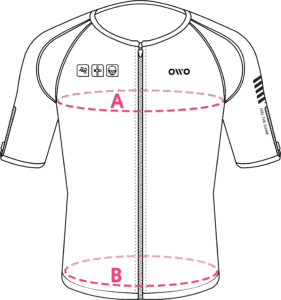
Measure your chest (A) and hips (B) following our indications.
The reference measurement will always be the larger of the two (A or B).
Look in the chart to which size corresponds to that measurement.
| Size | Reference measurements | |
|---|---|---|
| Inches | Centimeters | |
| 2XS | 25.6 – 29.4 | 65 – 74 |
| XS | 29.5 – 32.6 | 75 – 82 |
| S | 32.7 – 36.1 | 83 – 91 |
| M | 36.2 – 39.7 | 92 – 100 |
| L | 39.8 – 42.8 | 101 – 108 |
| XL | 42.9 – 46.3 | 109 – 117 |
| 2XL | 46.4 – 49.9 | 118 – 126 |
| 3XL | 50 – 53 | 127 – 134 |
| 4XL | 53.1 – 55.9 | 135 – 142 |

