14-Day Returns* · 2-Year Warranty · Worldwide Shipping, US included

14-Day Returns* · 2-Year Warranty · Worldwide Shipping, US included
14-Day Returns* · 2-Year Warranty
Worldwide Shipping, US included
14-Day Returns*
2-Year Warranty
Worldwide Shipping, US Included
Guide
OWO vs bHaptics: compare haptic technology, game compatibility, setup, etc.
by
OWO
-
August 17, 2026
Reading Time:
12 min read
OWO and bHaptics both bring haptics to your body. But if you are comparing them because you want to take gaming immersion as far as possible, the most important difference is not how many motors they have or how many games appear in their compatibility lists.
It is what happens when the game reaches your body.
bHaptics takes vibration beyond the controller and distributes it across the torso. OWO takes a different approach: supported in-game events are translated into distinct physical sensations using controlled electrical stimulation across individually calibrated muscle zones.
If deeper immersion is the main reason you are investing in wearable haptics, OWO is our recommendation.
Choose bHaptics if your priorities are the broadest compatibility, easier setup and an expandable vibration-based hardware ecosystem.
Instead of treating these products as two versions of the same haptic vest, it is more useful to compare what each one actually brings to the player.
Deeper embodied immersion beyond vibration.
Compatibility, convenience and ecosystem breadth.
32 vibration motors and 10 active muscle zones are not directly comparable numbers. They describe fundamentally different ways of creating haptic feedback.
Premium haptics only make sense if they meaningfully change the experience of playing.
A controller already vibrates. Adding more vibration points around the body makes that feedback considerably more directional and detailed. That is something bHaptics does well.
OWO was created around a different ambition.
Instead of simply letting your body know that something happened in the game, OWO is designed to make supported events become physical sensations on your body.
Your character fires a weapon. You can feel recoil. Your character receives an impact. The physical response can feel different. Other supported interactions can have their own sensation profiles instead of relying on variations of the same vibration mechanism.
Your screen lets you see the game.
Your headset can put you inside it.
OWO brings your body with you.
The goal is to make the physical distance between what happens to your character and what you experience as the player feel smaller.
OWO does not literally reproduce every possible event in every game. Each integration determines which supported actions become sensations and how those sensations are designed.
But when an event is supported, OWO gives developers a physical vocabulary that is not limited to vibration alone.
A physical signal tells you something happened.
More feedback points communicate direction and location.
Supported actions can have different physical identities.
If you are investing in haptics specifically because you want to push immersion further, we believe OWO offers the more meaningful technological step forward.
Controlled electrical stimulation works across 10 active muscle zones calibrated to your body. Supported events can use different signal profiles instead of relying on vibration alone.
The bHaptics TactSuit Pro uses 32 vibration motors to create patterns around the torso, changing location, direction, timing and intensity according to supported events.
bHaptics has a strong approach to directional information. A hit from one side can activate feedback on that side, while multiple motors can create patterns across the torso.
OWO adds another dimension: the physical character of the feedback itself.
Recoil does not need to be another vibration pattern. An impact does not need to be another version of the same buzz from a different direction. Different supported events can be designed to feel physically different.
This is the difference we think matters most:
bHaptics creates a sophisticated map of vibration around your body. OWO is designed to make the physical sensation itself part of the game.
Shooters compress many physical events into a few seconds. You fire, receive an impact and react to another event almost immediately.
Spatial vibration can help communicate where those events occur. OWO can also differentiate what those supported events represent through different sensation profiles.
For players who want to feel closer to the action rather than simply receive more feedback about it, that difference is central to the buying decision.
We do not need to pretend OWO wins every specification. Doing so would make this comparison less useful.
bHaptics currently has the larger compatible-game catalog.
Longer stated battery life than OWO’s approximately 8 hours.
No individual electrical calibration or electrode-to-skin contact.
Additional wearables can extend vibrotactile feedback beyond the torso.
Those are genuine advantages.
But they do not answer the most important question if immersion is the reason you are investing in premium haptics:
Which system gives me the physical gaming experience I actually want?
If you want the widest and simplest vibration ecosystem, bHaptics has a strong argument.
If you are looking for a more fundamental step beyond vibration, we believe OWO is the better choice.
bHaptics wins the raw number.
The more useful question is whether OWO supports the games that account for most of your actual playtime.
Do this before choosing:
If your favorite games are already among the 165+ OWO compatible titles, a larger catalog of games you may never play has much less influence on the purchase.
NATIVE
Direct integration connects supported game events to OWO sensations.
MOD
Dedicated modifications extend OWO into additional PC and PCVR games.
SIMHUB
Telemetry-based integrations bring physical feedback into racing and simulation.
OVERWOLF
Another integration route for selected PC experiences.
Yes. OWO supports Meta Quest 3, as well as Quest 2, PC and PCVR, with compatible console experiences also available.
The individual game still needs a supported integration. Headset compatibility does not automatically make every game compatible.
The technology that differentiates OWO also asks a little more from the player.
OWO calibrates active muscle zones to the wearer rather than applying one stimulation level everywhere.
The Vest comes in nine sizes from 2XS to 4XL because reliable contact is part of how the technology works.
Enough for long individual sessions, although bHaptics offers the longer stated battery life.
The gel pads need proper care and eventual replacement when they no longer maintain suitable contact.
If maximum convenience is your priority, bHaptics is easier.
If your priority is the physical experience OWO creates, these are the practical requirements that enable it.
After the initial calibration, your OWO settings can be saved and adjusted rather than recreated from scratch every session.
Yes. bHaptics is easier to pass between several users because its vest is adjustable and does not require individual electrical calibration.
OWO is more personal by design. Correct sizing matters and each wearer should use an appropriate calibration.
If both products cost several hundred dollars, pounds or euros, a small price difference should not determine which haptic technology you choose.
OWO uses regional pricing in several main markets:
United States
Eurozone
United Kingdom
Canada
Australia
Prices and shipping conditions can change. Always check the final checkout amount for your destination.
The bHaptics TactSuit Pro is currently listed at $565 in the United States before any additional shipping or taxes that may apply.
For a U.S. buyer, OWO’s current $569 delivered price and the bHaptics headline price are effectively in the same purchasing tier.
Choose based on the experience you want, not a difference of a few dollars.
The value is the ability to translate supported events into individually calibrated physical sensations beyond vibration.
The value is breadth: more games, simpler ownership and optional hardware expansion.
OWO
2-year warranty
14-day return period, subject to return and hygiene conditions.
bHaptics
1-year warranty
45-day advertised money-back window.
If you only compare specifications, bHaptics wins several rows.
If you compare what each product is trying to achieve, the decision changes.
This comparison is published by OWO. We are not going to pretend our recommendation comes from a completely neutral third party.
But we also do not recommend OWO simply because our name is on the product.
If our priority were the biggest compatibility list, the easiest vest to share or the longest battery life, bHaptics would have the stronger argument.
That is not why we believe players invest in premium haptics.
We believe they do it because they want to feel closer to the game.
We did not build OWO because gaming needed another place to vibrate. We built it because the player’s body remains one of the final boundaries between controlling a character and feeling present in that character’s world.
A screen can show you the action. Sound can surround you with it. VR can put the world around you.
OWO brings the physical layer of supported game events to your body.
If deeper immersion is what you are spending your money on, that is why we recommend OWO.
bHaptics is an excellent choice for broad compatibility, convenient vibrotactile feedback and an expandable hardware ecosystem.
OWO is the choice for players who want to take the next step: from receiving physical feedback about the game to feeling supported moments as distinct sensations on their own body.
That is the difference between adding haptics to your setup and bringing your body further into the game.
Check the games you play most. If they are supported, choose your correct Vest size and make sure OWO’s electrical-stimulation technology is suitable for you.
Then the question becomes much simpler:
Do you want another vibration device, or do you want to discover what your games can actually feel like?
If deeper immersion and physical sensations beyond vibration are your priorities, we recommend OWO. bHaptics has advantages in game-library size, battery life, setup simplicity and modular hardware expansion.
Choose OWO if you want supported in-game events to become distinct physical sensations rather than vibration patterns alone.
bHaptics uses vibration motors distributed around the wearable. OWO uses controlled electrical stimulation across 10 active muscle zones calibrated to the wearer.
bHaptics currently promotes 325+ compatible games, while OWO supports 165+ compatible games and growing.
No. The OWO Vest uses controlled electrical stimulation instead of vibration motors to create its haptic sensations.
OWO translates supported in-game events into physical sensations on the player’s body. Each game integration determines which actions are supported and how the sensations are designed.
Yes. OWO supports Meta Quest 3, but the individual game still needs a compatible integration.
bHaptics is strong at detailed directional vibration. We recommend OWO when deeper immersion is the priority because supported events such as recoil and impacts can use different physical sensation profiles.
OWO requires more initial preparation because the Vest needs direct body contact and each wearer completes a personal calibration. That calibration can then be saved for future sessions.
Check whether your favorite games are supported, find your OWO Vest size and bring the physical layer of the game to your body.
We accept
Secure Checkout
Shopping is always safe and secure
Easy returns
you can request a return within 14 days of delivery
Need more help? Email us or call (+34) 672712281
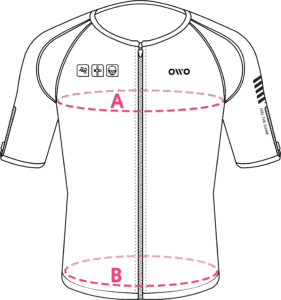
Measure your chest (A) and hips (B) following our indications.
The reference measurement will always be the larger of the two (A or B).
Look in the chart to which size corresponds to that measurement.
| Size | Reference measurements | |
|---|---|---|
| Inches | Centimeters | |
| 2XS | 25.6 – 29.4 | 65 – 74 |
| XS | 29.5 – 32.6 | 75 – 82 |
| S | 32.7 – 36.1 | 83 – 91 |
| M | 36.2 – 39.7 | 92 – 100 |
| L | 39.8 – 42.8 | 101 – 108 |
| XL | 42.9 – 46.3 | 109 – 117 |
| 2XL | 46.4 – 49.9 | 118 – 126 |
| 3XL | 50 – 53 | 127 – 134 |
| 4XL | 53.1 – 55.9 | 135 – 142 |

