14-Day Returns* · 2-Year Warranty · Worldwide Shipping, US included

14-Day Returns* · 2-Year Warranty · Worldwide Shipping, US included
14-Day Returns* · 2-Year Warranty
Worldwide Shipping, US included
14-Day Returns*
2-Year Warranty
Worldwide Shipping, US Included
New
Discover OWO Game, the most advanced haptic system for video games.
by
OWO
-
October 28, 2026
Reading Time:
7 min read
What are haptics? In simple terms, haptics is technology designed to communicate information through the sense of touch. The vibration that confirms a tap on your smartphone, the feedback you feel through a gaming controller or the physical sensations produced by wearable technology are all examples of haptics.
By adding touch to digital experiences, haptic technology can make interactions feel more immediate, intuitive and immersive. In gaming and virtual reality, it creates another connection between what happens on screen and what your body can physically perceive.
Haptic technology refers to systems that create or reproduce physical feedback that users can perceive through touch.
According to Unity, haptics uses touch feedback to simulate physical sensations, ranging from simple vibration to more advanced force-feedback systems.
One of the most important things to understand is that haptics is not the same as vibration. Vibration is one of the most common forms of haptic feedback, but haptic systems can also create resistance, force, movement, pressure and other physical responses.
A phone vibrating after a notification is a haptic interaction. So is a controller responding during gameplay, a racing wheel resisting your movement through a corner or a wearable device generating physical sensations across different areas of the body.
At a basic level, a haptic system takes a digital event and converts it into a physical response.
The process starts when something happens inside a game, application or digital system. Software interprets the event and determines what kind of physical response should accompany it. The haptic device then creates that response so the user can physically perceive what is happening.
In gaming, this could mean a weapon firing, a character receiving an impact, a heartbeat increasing or an environmental event becoming a physical sensation. The better the synchronization between the digital event and the physical response, the more natural and immersive the interaction can feel.

Different haptic technologies generate that final response in different ways. Some systems rely on vibration, while others use force, movement, pressure or electrical stimulation to create physical feedback.
Sensors and actuators perform different roles in a haptic system. Sensors detect information such as position, movement or interaction, while actuators create the physical feedback the user actually feels.
In gaming, the input does not always need to come from a physical sensor. The game already knows when the player fires a weapon, receives an impact, interacts with an object or enters a new environment. These digital events can be used directly to trigger appropriate haptic feedback.
There is more than one way to deliver haptic feedback. Different devices use different technologies depending on the type of interaction they are designed to reproduce.
Common examples include smartphones, gaming controllers, force-feedback systems, haptic gloves, motion platforms and wearable haptic devices. Each format provides a different way of introducing touch into a digital experience.

Smartphones and touchscreens: small vibrations can confirm touches, gestures, notifications and other digital interactions.
Gaming controllers: haptic controls can communicate actions, impacts and environmental events directly through the hands.
Force-feedback systems: steering wheels and other devices create resistance and physical forces to communicate information about movement or conditions.
Haptic gloves: gloves can provide tactile feedback or resistance when interacting with virtual objects.
Motion systems: platforms and seats physically move in response to vehicles, environments or simulated events.
Wearable haptic devices: vests, shirts and other wearables move haptic feedback beyond the hands and distribute physical sensations across the body.
Haptics is used anywhere touch can improve communication, control or immersion. Its applications extend far beyond entertainment.
Consumer electronics: phones, watches and touch interfaces use physical cues to confirm actions and communicate notifications.
Automotive interfaces: steering wheels, seats and controls can use haptic feedback to communicate information without requiring constant visual attention.
Training and simulation: haptic systems can reproduce resistance or physical events in medical, industrial and professional simulations.
Robotics: haptic feedback can help remote operators perceive contact and resistance while controlling robotic systems.
Gaming and VR: haptic interfaces add touch to interactive worlds, making digital actions physically perceptible.
Gaming is one of the clearest examples of how haptic technology has evolved. Traditional systems mainly used controller vibration to indicate that something had happened.
Haptic technology has evolved far beyond traditional controller rumble. D-BOX highlights how physical feedback can be synchronized with audiovisual content to make digital experiences more immersive.
Modern haptic interfaces can communicate more information by changing location, duration, intensity, timing and the type of response. Instead of every event feeling the same, different gameplay actions can produce different physical sensations.
Virtual reality makes the absence of touch particularly noticeable. You may see a virtual object directly in front of you and reach toward it naturally, but without haptics there is often no physical confirmation when contact occurs.
VR controllers already provide part of that feedback. Wearable haptic devices can extend the same concept across larger areas of the body.
Haptic systems are increasingly used in immersive entertainment and virtual reality, where physical feedback helps connect virtual events with the user’s body. Sandbox VR provides another overview of how haptic technology contributes to immersive experiences.
The goal is not simply to create more feedback. It is to improve the relationship between what happens in the virtual environment and what the player physically perceives.
Wearable haptic devices turn parts of the body into an interface. Instead of receiving all physical feedback through the hands, sensations can be delivered to different areas according to what is happening in the digital experience.
Different wearable systems use different technologies. Some rely on vibration motors, while others use mechanical pressure or electrical stimulation.
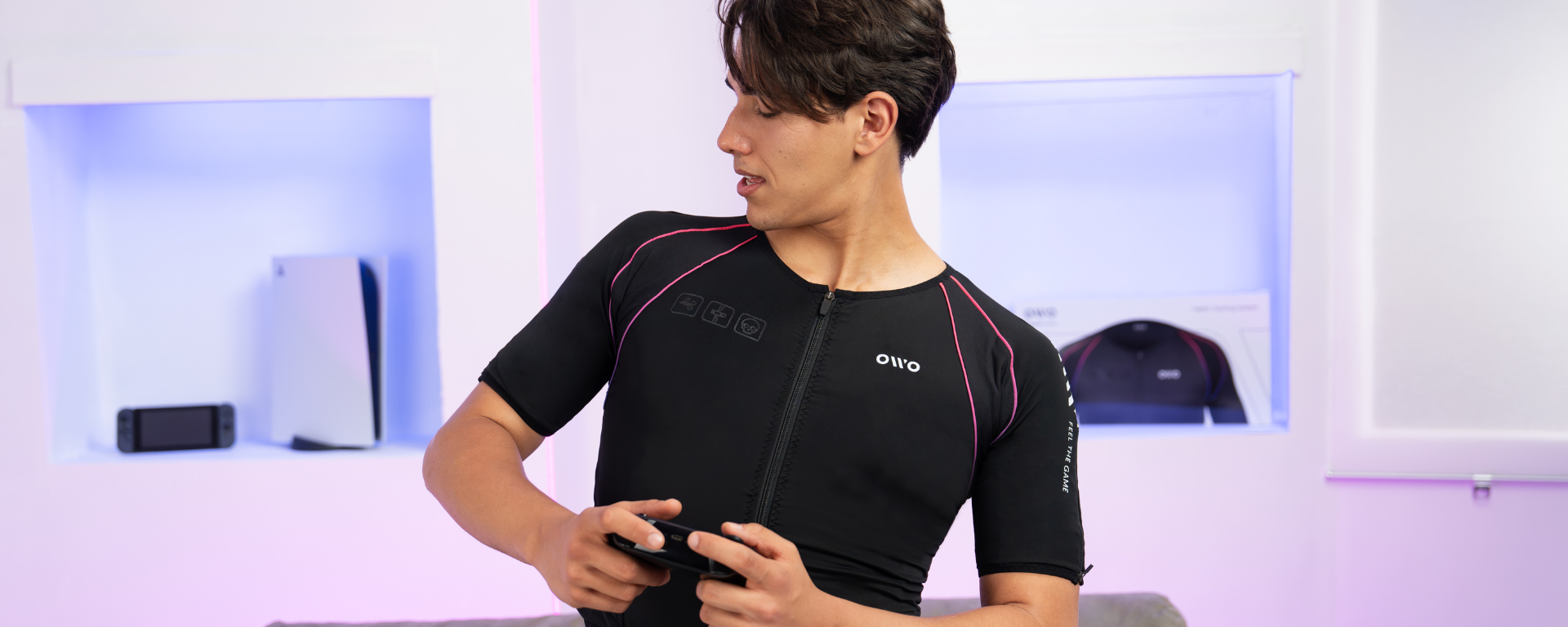
OWO Skin uses electrical stimulation rather than vibration. Supported digital events are transformed into sensations that can be delivered across different areas of the upper body.

With 10 active zones and configurable sensations, OWO can reproduce supported gameplay events such as impacts, recoil, environmental effects, movement and other physical interactions.
Synchronizing sight, sound and touch can make digital experiences feel more cohesive.
Physical cues can communicate events without adding more visual information to the screen.
Touch mirrors a way people naturally understand and interact with the physical world.
Physical feedback helps bridge the gap between seeing a virtual event and experiencing no physical response.
The future of haptic gaming is unlikely to be defined simply by stronger vibration. It will be defined by more meaningful information through touch.
As hardware and software evolve, haptic feedback can become more precise, localized and closely synchronized with specific digital events.
Wearable devices can also move feedback beyond controllers, making touch part of the player’s body and allowing developers to treat physical sensation as another creative layer alongside visuals, audio and gameplay mechanics.
A sword swing, environmental effect, vehicle movement or heartbeat does not need to produce the same response. More advanced haptic systems make it possible to design each event differently.
Haptics is technology that allows digital experiences to communicate through touch.
It can be as simple as a phone vibration or as sophisticated as force-feedback systems, motion platforms and wearable haptic devices capable of delivering localized physical sensations.
For gaming and virtual reality, the potential is clear. Visuals show you the world. Audio lets you hear it. Haptics gives you the possibility to feel it.
As virtual environments become increasingly detailed and interactive, touch is becoming another fundamental part of digital immersion.
We accept
Secure Checkout
Shopping is always safe and secure
Easy returns
you can request a return within 14 days of delivery
Need more help? Email us or call (+34) 672712281
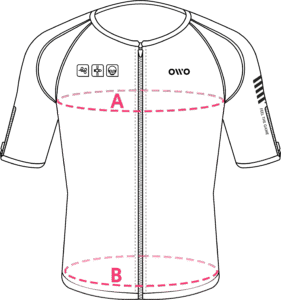
Measure your chest (A) and hips (B) following our indications.
The reference measurement will always be the larger of the two (A or B).
Look in the chart to which size corresponds to that measurement.
| Size | Reference measurements | |
|---|---|---|
| Inches | Centimeters | |
| 2XS | 25.6 – 29.4 | 65 – 74 |
| XS | 29.5 – 32.6 | 75 – 82 |
| S | 32.7 – 36.1 | 83 – 91 |
| M | 36.2 – 39.7 | 92 – 100 |
| L | 39.8 – 42.8 | 101 – 108 |
| XL | 42.9 – 46.3 | 109 – 117 |
| 2XL | 46.4 – 49.9 | 118 – 126 |
| 3XL | 50 – 53 | 127 – 134 |
| 4XL | 53.1 – 55.9 | 135 – 142 |


